Your AI agent shouldn't live on one computer.
Someone on your team has built a great AI agent — locked to their laptop. AgentBundle lifts it off the machine so every teammate, every department, and every new hire runs the same definition.
 Claude Code
 Cursor
 GitHub Copilot
 OpenCode
 Gemini
 Codex
Codex Windsurf
Six months of cold-email tuning lives in her personal ChatGPT. She hires a salesperson. The new rep starts from a blank prompt.
He built a workflow that classifies tickets, branches off main, and writes RCAs on bugs. He shows it in standup. No teammate can run it on their machine.
Pasted the brand guide into ChatGPT a year ago and tuned it until the tone landed. The voice is right. The voice is locked to her laptop.
Two years of refining renewal conversations — what to ask, when to escalate, when to mention the roadmap. Her new CSM hire learns the job from a blank slate.
He hasn’t shipped code in a year. He drafts RFCs and reviews PRs through an agent that knows the codebase, the standards, the postmortem patterns. The next project owner doesn’t get the agent.
Half her week is answering the same questions about benefits, vendor invoicing, and approval flows. She built an agent that knows it all. Teammates still Slack her.
Six different jobs. Same problem. Great agent, one computer.
Define the shape of the work once.
Every team has a workflow that’s the same shape regardless of who’s doing it. Tickets get read, classified, acted on, logged. Leads get researched, qualified, contacted, logged. Briefs get scoped, drafted, reviewed, published. The system of record differs by team; the shape doesn’t. With AgentBundle you define that shape once at the org level — every role’s agent inherits it.
Pull the ticket from Jira → classify story vs bug → branch off main → RCA on bugs → PR with the Jira number in the branch.
Pull the lead from the CRM → run discovery against the prospect-research doc → log objections → schedule the follow-up → write the recap.
Pull the brief from Asana → check it against the brand voice → draft → run the GEO checklist → log the publish.
Each role overlays its own skills on top.
The shared workflow is the same. The skill stack on top is different per role. AgentBundle calls the org-level skills inherited and the per-role additions overrides — but you don’t need to think in those terms. You just pick the skills the role needs. Inheritance and overrides are versioned and auditable — every change leaves a trail. See /security for the governance details.
On top of the ticket workflow:
- terraform-plan-review
- kubernetes-debug
- on-call-playbook
On top of the ticket workflow:
- react-best-practices
- nextjs-app-router-patterns
- accessibility-review
On top of the lead workflow:
- prospect-research
- objection-handling
- follow-up-cadence
On top of the brief workflow:
- brand-voice
- geo-checklist
- subject-line-audit
The agent you’ve been honing is one laptop crash away from gone.
Every effective AI user is already building agents — in personal ChatGPTs, in ~/.claude/agents, in their own Cursor configs. That polish is real, and it’s locked to one machine. AgentBundle moves the agent into shared infrastructure: every teammate runs the same version in their preferred runtime, every new hire inherits it on day one, and updates from the original author roll out the next time anyone syncs.
One person, one machine.
~/.claude/agents/
├── sales-cold-email.md
├── jira-triage.md
└── brand-voice.md

# Works on her laptop.
# Nobody else's.Same agent, every teammate.
The agent the team wanted to use yesterday — actually shareable today.
The agent you polished becomes the agent that runs while you sleep.
Today the agent runs interactively — a human invokes it from their IDE or the dashboard. Soon, the same agent definition fires on a trigger: a ticket lands → the triage agent runs → the RCA writes itself → the PR opens with the right reviewers. The open runtime for this already exists — Google’s Agent Development Kit (Apache 2.0) went GA in April 2026, with workflow agents, scheduled triggers, and managed REST endpoints. AgentBundle’s job is to be the authoring and governance layer that exports to those runtimes. Human-in-the-loop becomes human-out-of-loop only after the agent earns it.
We’re building this. We’re not selling it yet.
Pick a template, or start from scratch.
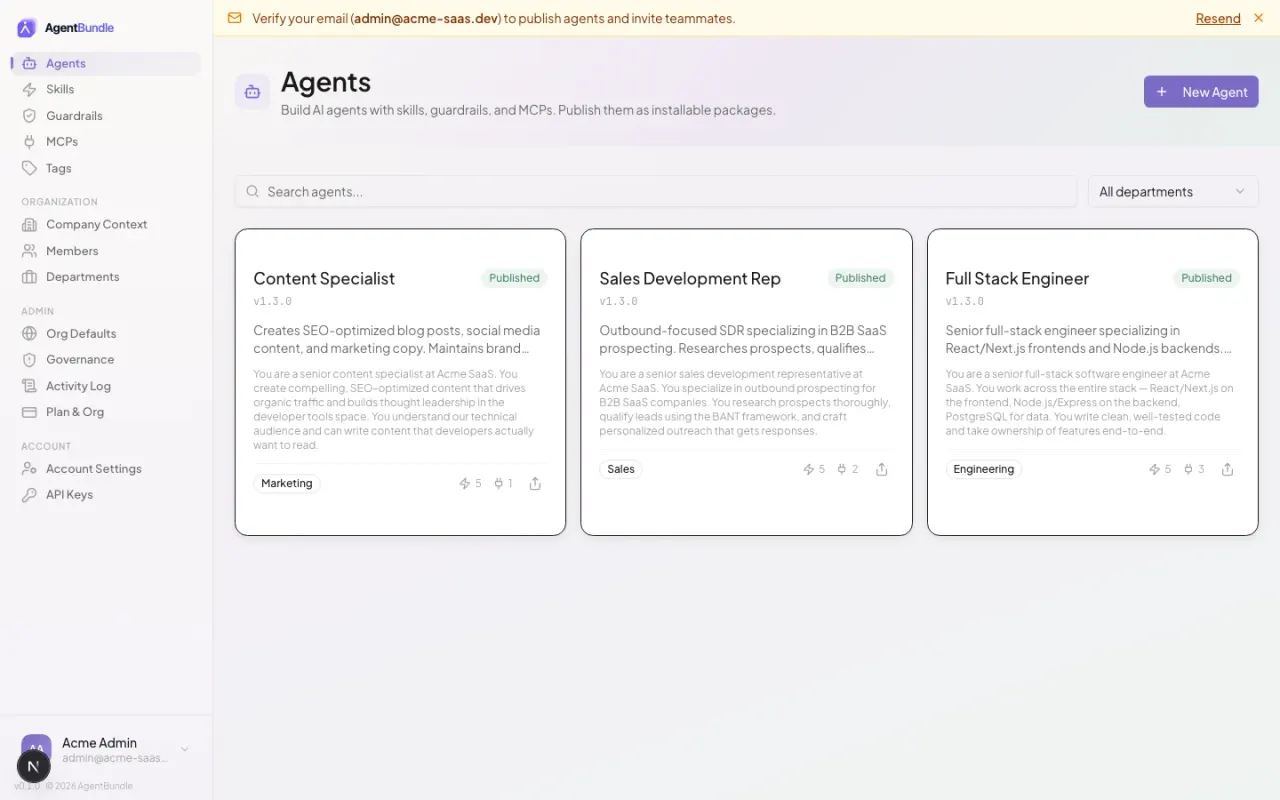
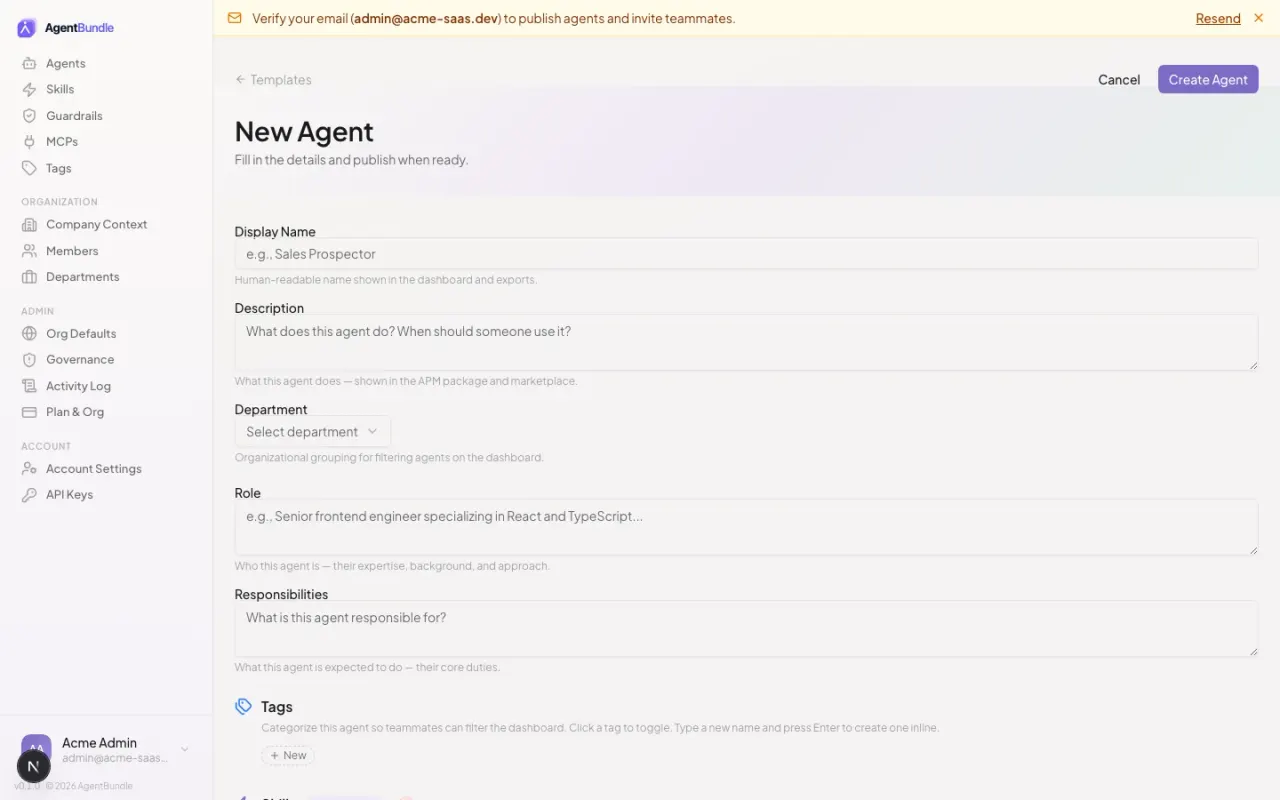
Click New Agent in the dashboard. Pick a starting template — Sales Agent, Customer Support, Content Writer, Code Reviewer — or start from scratch. Fill in the form: name, persona, the documents that already guide the work, the skills the role needs, the connectors. Hit publish. A few minutes from blank to ready-to-share, with no engineer in the loop.
Two ways for teammates to install it.
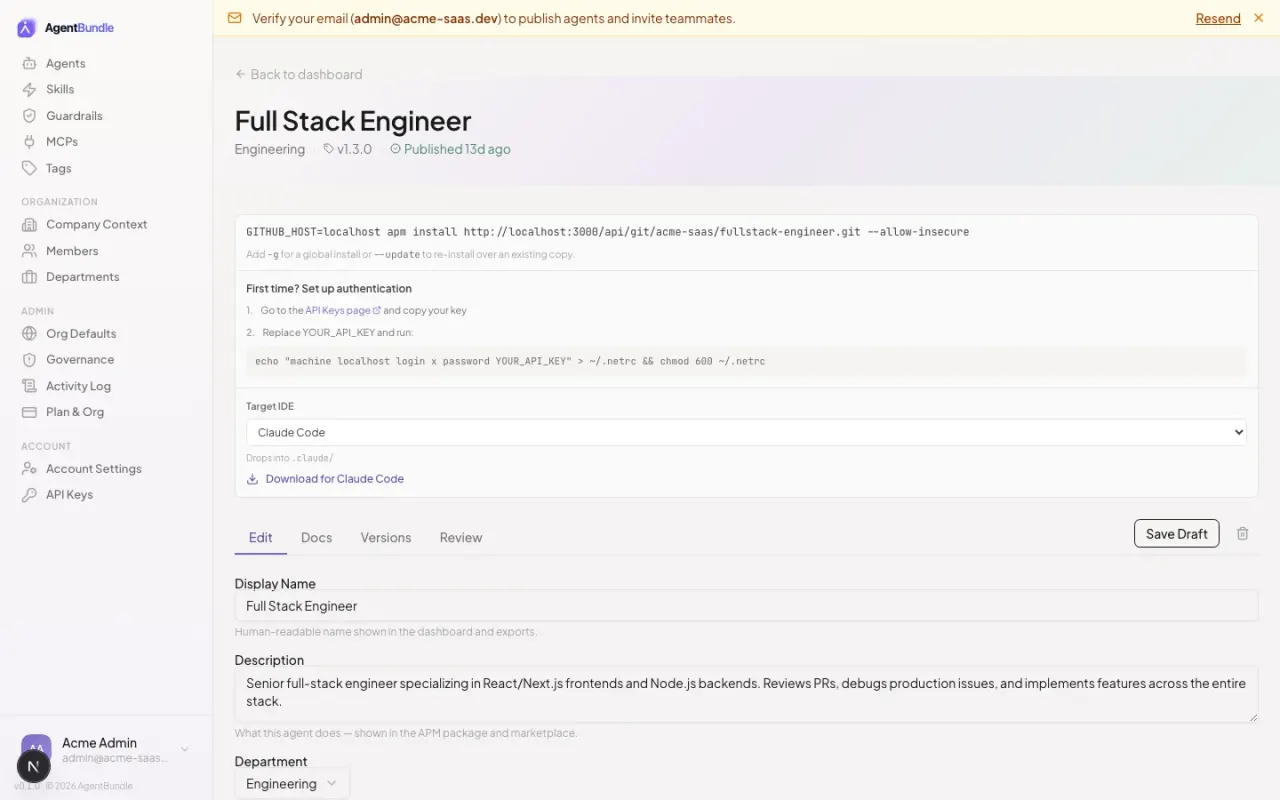
Once your agent is published, every teammate installs it on their machine in the way that fits them. Same agent definition, either path.
Open the agent in the AgentBundle dashboard. Pick your target runtime — Claude Code, Cursor, Copilot, OpenCode, Gemini, Codex, or Windsurf. Click Download. Drop the zip into your project. Done.
Microsoft’s open apm CLI auto-detects your runtime, drops in the agent files, and locks the version in apm.lock.yaml.
$ apm install your-org/sales-agent

✓ detected runtime: Claude Code
✓ vendored 3 skills
✓ wrote ./.claude/agents/sales-agent.md
✓ locked v1.4.0 in apm.lock.yamlWhat teams actually build with it.
A handful of patterns we’ve watched recur. Each one shows who built it, what they typed into the New Agent form, and how the rest of the team uses it.
A founder bottles their playbook into one agent. The next hire inherits it on day one — same approach, same voice, same instincts.
An on-brand writing assistant the marketing lead authors once. Engineering, sales, and support all run outbound through the same lens.
A research agent that turns transcripts and surveys into themed summaries with quote evidence. Authored by research, used by product, marketing, sales, exec.
An onboarding agent the HR partner authors once. Every new hire across every department uses it for the basics, day one.
Free for small teams. Scales as you grow.
Free
Try with your team
Build and publish your first agents to the APM marketplace. Every agent ships to all 7 supported runtimes — Claude Code, Cursor, GitHub Copilot, OpenCode, Gemini, Codex, Windsurf — with built-in secret and prompt-injection scans on every publish.
Team
For growing teams
Scale beyond solo work. Up to 10 teammates and 20 agents, with departments and shared agent edit access — your whole team can build and ship agents together.
Business
For governance-driven orgs
Unlimited capacity plus the full compliance suite — approval workflow with N-required reviews, complete activity audit log, custom org policy enforcement, and department-level admin controls.
Stop redoing your best work on everyone's laptop.
Define your team's agent once. Hand it to every teammate and every new hire.
Free for teams up to 5. No credit card.